
Multiple Sclerosis (MS)
Multiple Sclerosis is explicitly listed in Medicare's qualifying criteria for CRT power wheelchairs. Because MS can cause severe fatigue, weakness, heat sensitivity, and balance issues, a custom power wheelchair is often medically necessary to maintain independence.
Key Configurations: Power tilt and recline are frequently prescribed to help manage severe fatigue and allow the patient to rest without transferring out of the chair. Additionally, the chair's electronics can be programmed to accommodate tremors or sudden weakness.
"MS is characterized by periods of relapse and remission. When configuring a wheelchair for an MS patient, the clinical team must design the equipment for the patient's worst functional state, not their best day."
Amyotrophic Lateral Sclerosis (ALS)
Amyotrophic Lateral Sclerosis (ALS) is a rapidly progressive neuromuscular disease. When prescribing a power wheelchair for an ALS patient, the clinical team must look ahead. The chair ordered today must be capable of accommodating the severe functional losses the patient will experience six months or a year from now.
Expert Tip: Expandable Electronics for ALS
Power wheelchairs for ALS patients MUST be equipped with "expandable electronics." This means the chair's computer system can be easily upgraded from a standard hand joystick to alternative drive controls (like a head array or eye gaze technology) as the patient loses function in their arms, without needing to purchase an entirely new wheelchair.
Stroke with Hemiplegia
A severe stroke often leaves a patient with hemiplegia—paralysis or severe weakness on one side of the body. This unique physical presentation makes standard mobility devices dangerous or impossible to use, often necessitating a custom power wheelchair.
Key Configurations: Stroke patients typically require the joystick to be mounted on their unaffected side. However, if they suffer from visual field deficits or cognitive neglect (common after a stroke), the clinical team must carefully assess if they can safely navigate their environment. Power tilt is also crucial to manage spasticity and tone in the paralyzed limbs.
Spinal Cord Injury (SCI)
Individuals with high-level spinal cord injuries face unique and severe mobility challenges. Because they have a complete loss of sensation and motor function below the level of their injury, they are entirely dependent on their wheelchair for mobility and are at the highest possible risk for pressure injuries.
Mandatory Power Tilt
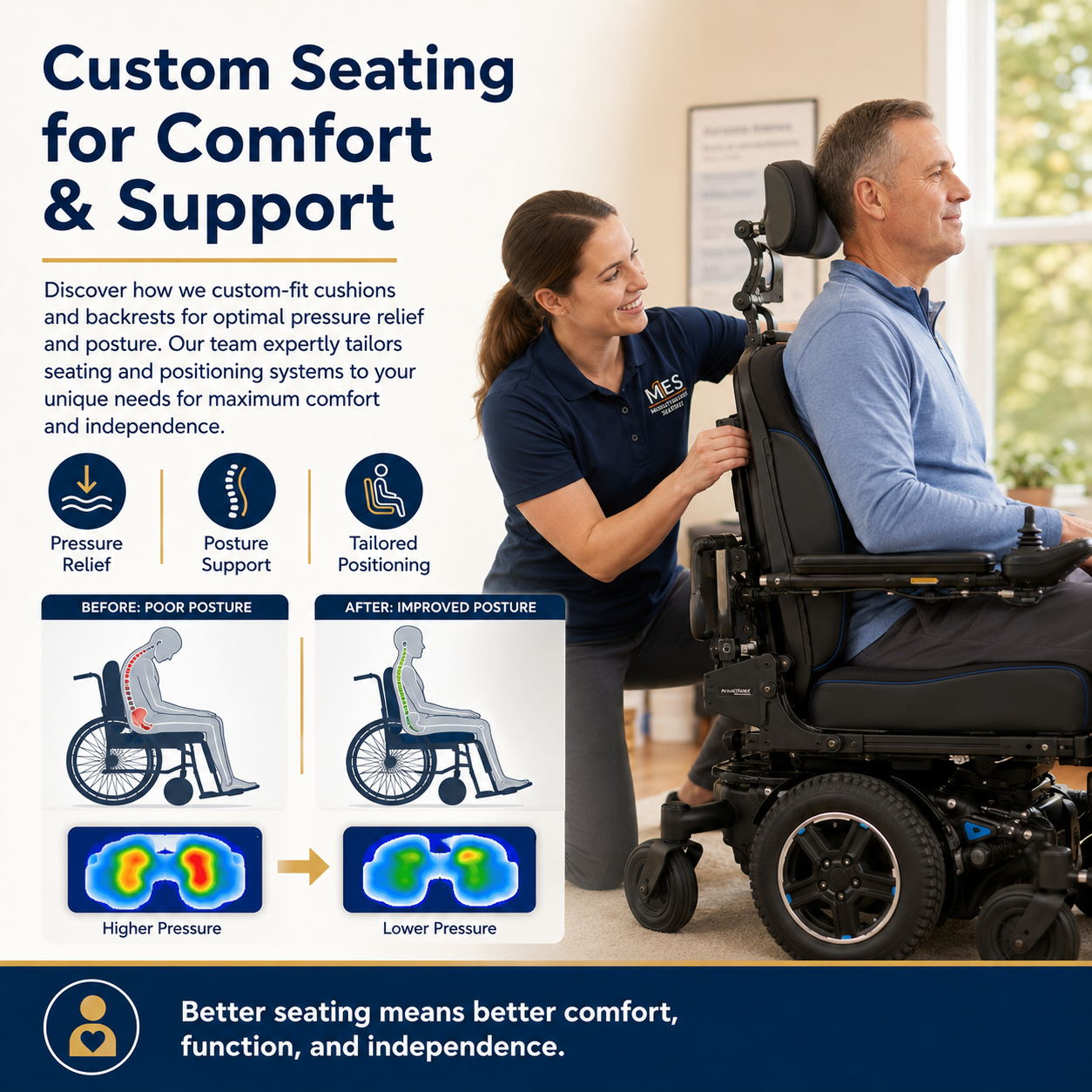
For SCI patients, power tilt and recline functions are not optional; they are medically necessary for survival to perform mechanical pressure reliefs and prevent life-threatening skin breakdown.
Alternative Drive Systems
Depending on the level of the injury (e.g., Cervical vs. Thoracic), patients may require specialized drive controls like sip-and-puff or chin controls to operate the chair independently.
Parkinson's Disease
Parkinson's disease is explicitly listed in Medicare's qualifying criteria for CRT power wheelchairs. As the disease progresses, patients experience severe tremors, rigidity, bradykinesia (slowed movement), and dangerous postural instability, making walking highly hazardous and leading to frequent falls.
Key Configurations: One of the greatest benefits of a complex power wheelchair for a Parkinson's patient is the programmable electronics. The ATP can adjust the joystick's sensitivity, increase the "deadband" (the amount the joystick must move before the chair responds), and add "tremor dampening" programming so the chair drives smoothly despite the patient's tremors.
Verified Clinical Sources:
- [1] NCART. "What Is Complex Rehab Technology?" Read source
- [2] MSKTC. "Preventing Pressure Sores." Read source